Thursday, April 24, 2014

Making a Simple Elegant Nuno Felt Scarf

After several requests for instruction on making a simple nuno felt scarf, I finally decided to allow the time and energy for the making of a video.  

Elegant Nuno Scarf
showing (wool) front
I feel quite challenged to make work that is both mainstream and commercial, so that was part of 'the brief' I set myself. With Melburnians' penchant for all things black when it comes to clothing (and like a once good friend - brown on a good day) black silk Georgette was chosen as the carrier fabric and my canvas.

Around this time last year I had purchased from First Edition Fibres in country Victoria a merino silk blend, which I thought would make an excellent complement to the black silk Georgette.  I love the silk merino blends from First Edition Fibres, in particular the 70% silk 30% merino blend, which when felted on felter's gauze can give an effect that's quite lacy and delicate. The silk merino blends tend to take longer to felt but the effort is usually well worth it.


As I finished laying the merino, I decided to keep it simple and not use the silk hankies I'd introduced at the beginning of the video. Sometimes the work can have its own momentum; and as a painting teacher used to tell me 'let it be what it wants to be'.  My surfaces tend to be painterly, achieved by laying the fibre in various directions.  But this method of laying also produces a stronger laminated fabric.  If you intend to go onto trying your hand with a felted Nuno garment, I suggest getting used to varying the direction of the way you lay the fibre, as well as, rolling the fabric from each direction, turning it at 90 degrees each time.

A couple of weeks ago when my partner Philip referred to my 'Tell Tale Venus' ensemble as 'frou-frou', I was taken aback; then, looked up its meaning and discovered that it can refer to a rustle of fabric or a swishing sound.  The idea has caught my imagination to make Nuno felt that rustles.  I know Philip didn't mean it in that sense but that's the positive that I'll take from his remark.

Hope you enjoy the video.

The Materials
  • For silk and fine merino blends see, First Edition Fibres.  The blend used in the video consists of 60% fine merino 40% tussah silk fibres that is 'randomly dyed', no 0464. 
  • For acid dyes for my silk and wool products, I use "Landscape Dyes" which are available from Kraftkolour, and they produce a wonderful guide for using the dyes. 
  • The black silk Georgette was purchased from a colleague who was getting rid of her stash because she was no longer felting.  If you haven't purchased the fabric yourself, you can never be quite sure about its quality, shrinkage, or from whence it originated.  The dye ran quite a bit, which I found unusual for commercially dyed black silk.
Every once in a while you may hear the pitter patter of doggie feet, as Maudie the Lab comes in and out of the studio, and on occasion her whining, as she wants attention or to play ball. She's turned into a terrific studio dog and no longer runs off with everything she sees.  Last but not least, I'd like to acknowledge and thank Philip for the many hats that he wears - filming, directing, as well as piecing together the hours of footage. His advice, input and understanding are always invaluable.


close-up front
Elegant Nuno Scarf
reverse (silk fabric) side
close-up reverse


Buy the Downloadable DVD

I love making my Nuno pieces and I have invested heavily in buying books, trying different processes and learning tips and techniques along the way. My downloadable DVD tutorial short cuts much of this process for you and guides you step-by-step in a way that wasn't available for me when I began to learn to felt.

It takes some time to plan, create and produce a DVD for your enjoyment and information.  Your $5 US investment is a nominal fee to cover my time and expertise, buy my film crew (of one) a cup of coffee so he'll help me with the next one, and I also donate 20% of the income to Project Kolkata.  It represents a fraction of the cost of participating in a workshop or purchasing an instructional book.  In addition, if you purchase the downloadable DVD, I will respond to any query where you might require assistance when you begin to make your own simple yet elegant Nuno felted scarf.


DVD Trailer:  Watch the trailer of the making of the scarf (this blog trailer is lower quality than the DVD).


DVD Tutorial:  To watch the full DVD tutorial please make a $5 US payment to my hotmail email address -
 jonicornell@hotmail.com - through the PayPal link below.

(Note:  You don't need a PayPal account)

Remember to use my hotmail address - jonicornell@hotmail.com
and add in the comments section the words "Simple Nuno Felt Scarf"

Please allow up to 36 hours for me to respond - especially if you are overseas.  I will email you the download link with the subject line, "Joni Cornell Simple Nuno Felt Scarf", and instructions for downloading the file.

Please make sure you check your junk mail if you are using an email filter.

Happy viewing, Joni

***An update
Please note that this DVD is no longer available.  There is free viewing available at YouTube (link following)

https://youtu.be/I0ZybwUs2jQ

After a back injury my partner Philip invented a wet felt rolling machine to enable me to continue felt making.  I was so impressed with the prototype that I encouraged him to take it to production, so that the rest of the world of felt-makers could enjoy its unique benefits.  My method of making felt has changed but my fabrics are still of great quality and beauty.
You can find the wet felt roller at gentleroller.com.au


Wednesday, April 9, 2014

Tell Tale Venus: Finding the balance between beauty and meaning


Tell me about the theme…  I’ve looked for aspects of my life and work where I strive for balance - usually between beauty and meaning, which reminds me of a corny Kris de Burgh song ‘the head and the heart’.  It’s as I don’t trust Keats’ lines that 'beauty is truth, truth beauty/that is all. Ye know on earth and all ye need to know’ (Ode on a Grecian Urn).  I feel I sometimes sacrifice beauty for meaning.  There has always been this struggle between my head and my heart…a thing of beauty can make me weep but my head wants to know what it is about it that makes me weep.  I can’t accept the raw experience at face value.  

Sandro Botticelli, The Birth of Venus

1486 (Uffizi, Florence)


Ruskin rings more true, when he writes that ‘the twin purposes of art are to make sense of pain and to fathom the sources of beauty’ ("On Possessing Beauty" Alain de Botton).  I would tweak it slightly to include, as well as make meaning. Art has tended to define my criteria of beauty.  Nothing is more beautiful and enigmatic in terms of woman, or the aesthetics of painting, than Botticelli’s Venus.


About a decade ago writing my MA thesis on how art can become the container as you explore feelings, thoughts and your experience, I created a series of montages using a reproduction of the image (in reverse) and a photocopier to depth my own experience of woman/Venus, where in one state of the montages, I clothed her in a pinkish garment with a flower motif. 

image montage by Joni Cornell

As a ‘Venus’, a ‘heavy woman’ on the threshold of old and new experience, I felt too naked and so I clothed the Venus/me. This ‘clothing’ is not just physical but goes to the core of my psychological experience (with needing to hide sometimes). What I’ve made for the Balance exhibition is another representation of Venus’s garment.  I’m well aware that the garment is limited by my skills, vision and the functionality of my ‘wearable’ art pieces.  The tunic is earthy, and bound by notions of nakedness and modesty ('would/could I wear it' is something I ask myself as a maker), as well as my ability as a felt maker.  The mantle attracted because it's circular in shape and twin in function but whether you wear it as a collar or peplum, it is another layer with which to protect.


Working with the colour pink too – has meaning – pink for flesh (but it’s not just pink but ‘rose quartz’ with grey/black worked into the colour-way and I like this aspect of ‘dirt’ or soiling in the pink like myself as a Creole - not quite white but 'coloured'); and red (for passion and blood). When I was young, I couldn’t abide wearing pink and red together, until an artist suggested they were analogous and naturally went together.  My partner’s reaction upon seeing the finished ensemble was ‘it’s so pink…and frou-frou...’ 
‘But pink is Venus’ colour,’ I retorted. 
'Venus wouldn’t wear pink.' 
'Pink is the colour of the heart chakra and love…but in any case it’s not entirely pink!!!' 
I suppose it is ‘frou-frou’ compared to what I usually make. I like the idea that Venus’ garment (if she wore one as usually she is scantily clad) would ‘rustle’ (it's hard to make felt rustle) and be feminine and showy.

It is not irrelevant that I am reading Marcel Proust’s In Search of Lost Time which has reminded me of my own bond with a Botticelli painting, as well as the way art functions in my life. Monsieur Swann, you see, falls in love with Odette de Crecy because she reminds him of the Botticelli ‘type’. He puts a reproduction of the painting (which incidentally is not The Birth of Venus), on his bureau rather than a photograph of Odette, which is really quite an odd thing to do but doesn’t seem at all odd to me.  As a Creole woman, I can never be the Botticelli type but that has not extinguished my fascination and love for the painting. Venus was born of the foam as a grown woman – the painting by Botticelli is steeped in symbolism and redolent with meaning.  There is the neo-platonic reading of the painting which Botticelli’s contemporaries would have held looking at the painting - Venus’ physical beauty leads to thoughts of the Creator and divine love. It also tells us about the powerful Medici family who commissioned the painting and whose patronage was the source of the flourishing of the arts and sciences during the Renaissance.  If not for Lorenzo, Botticelli wouldn’t have had the freedom to explore his ideal of beauty and his love of the sensual. Most of the painting’s meaning is lost to us now, unless we seek it out.  It’s not just a beautiful image but you could if you wanted, ignore its meanings, see it as a beautiful painting about a beautiful woman, with her strange but beautiful attendants.  You could but I can’t...Aside from the art historical meanings the painting holds personal meanings for me, which have changed as I’ve grown into adulthood and changed. The thing about art is that not only can it inspire love (as with Monsieur Swann), but as I’ve found, it can companion you as you experience life, and it can console when no one else can.

mantle laid out ready for wetting

mantle at pre-felt with roses attached

Tell me about the making… in the garments (tunic and mantle) I’ve used vintage fabrics, including a 50 something year old dressing gown that my grandmother made for my mother, which she wore for her lay-in bed after she gave birth to me.  At one time I wore it too, as I tried to encourage a swelling in my womb.  For several years now I’ve been upcycling using this dressing gown, which I’ve always found quite an ordinary garment though it has enormous sentimental value as my only family ‘heirloom’.  I’ve included it in a story cloth, made a dress, and have cut up bits and felted them into scarves depicting ‘home’.  This ‘upcycling’ is my way of allowing the original garment to live on in different forms.  I have also included fragments from a 20 year old skirt (oh the stories this skirt could tell about a mid life crisis) and left over bits from a silk pair of pantaloons I made around the same time.  They are fabric fragments from life, fragments of a life of which I've spent time making.  I tried out the 3-dimensional roses on the mantle first to see whether I would like the effect when the fabric was fully felted. 


my grandmother's

tight stitches

running stitch

sewing running stitch


Tell me about  - the balance between beauty and meaning…  Reflecting on my grandmother making the dressing gown (and of course my mother as a young woman) as I unpicked the seams, and trying hard not to tear it in my frustration with the tight stitches.  ‘Oh Grand-mere, how could you stitch so tightly?’ I've asked under my breath.  Yet I've mirrored the small stitching in my running stitch in silk and cotton threads.

Then I’ve opened up where the seams have been and found the print still bright and new. Once I would have found this not beautiful, just as I found the Venus de Milo not beautiful because she was not ‘whole’.  As a young girl I couldn’t abide ruins or broken statuary.  I congratulate myself on my tastes having grown up. We are like this too – broken and not whole, not beautiful and beautiful and life is about coming to terms with these aspects of the human condition. Botticelli’s Venus is so perfect (yet, not quite – the painter has drawn her flat rather than naturalistic and the painting is like a frieze); and what I like is that she stands on the threshold as a new born (like any new born) with the world at her feet and all her attendants at her beck and call. Here is a place of ‘balance’ – this in-between, this liminal experience of threshold, this between breath experience that Buddhists love…the idea of balance is a paradox.  It’s a moment, and broken when the next step or breath is taken (an aha moment indeed - can you see how a painting if you allow it, can become personal and lead you towards making meaning?) … 

And my grandmother, who has been dead almost fifty years, well she makes her presence felt (no pun) not only in my heart, but in work that I make.  (I think I have enough of the dressing gown left for one more piece in the future). 


tunic at pre-felt

finished tunic

(back view)

finished tunic

(front view)


Venus with her attendant

finished tunic

(back detail)

finished tunic

(without mantle)


finished ensemble

mantle as peplum

finished ensemble

mantle as collar


Venus' ensemble modeled by Natalie Cooper, attendant tunic modeled by Kym Coates.

Friday, September 6, 2013

A Devotional to Frida Kahlo

Laid up with excruciating sciatica pain, my mind started to meander towards Frida Kahlo’s experience, not that I could in any way compare my pain to hers. But the immobility and what she managed to do with it…I’ve shared the couch with Maudie the dog and found the most comfortable position to be flat on my back and with the affected leg raised.  Other than checking email, or Youtube for exercises to ease my pain and the restriction in my leg, I didn’t manage to do much.  The laundry basket piled up, the floors needed vacuuming and mopping; there was also a piece of felt that needed finishing and rinsing.  All went undone, until my mother suggested I get up off the couch and start moving my body.   So I dragged myself up and hobbling about started on the chores, retreating back to the couch when the pain screamed down my leg, which was every few minutes or so.

But Frida…she painted and drew a whole oeuvre, and quite a great deal of it on her back.  She managed through the pain to make herself into a work of art too, managing her ‘toilette’ so that she was always beautiful, with her hair piled up and twisted with flowers; whereas, my hair got quite feral and close to turning into dreadlocks, when all I could manage was to brush it off my face and hold it back with an elastic band.  As a woman I find Frida touches me on so many levels – the ordinariness of her work, drawing from her reality and the bold determination and often defiance, of her beautiful face.  She never ‘let herself go’ in the modern parlance.


Detail of Bout's painting 
 And those tears…it’s common knowledge that Frida was influenced by small Mexican votive paintings but there is also a tradition in Western painting of tears as devotion, tears not as painful but as pious. There’s a small medieval devotional painting by Dieric Bouts called Weeping Madonna that is a superb example of the devotional and it was meant to move the viewer, when meditating upon it, to tears.  Bouts' painting was produced to encourage the viewer to identify with the Madonna or the Christ (the picture has its companion piece) and to feel over time that their tears were your own. 


I can't help but relate Frida's focus on tears to this type of painting. It may be that Frida wanted us to be moved by her tears, to cry with her, for her, as well as ourselves. She stares out at us, for instance in Broken Column (1944) unlike a mediaeval saint that usually looks heavenward, strapped in her corset, the Doric column representing her broken vertebrae or centre, small nails or tacks dig into her flesh, as well as the fabric that wraps around her lower torso, the tears falling milky and intense. The tacks could be thorns. She doesn’t look to heaven for her salvation, but towards us, the viewer. As the Madonna in Bouts' painting will never stop crying, so too will Frida's tears be eternal. There's another Self Portrait (1940) in which Frida wears a necklace/crown of thorns, so the evocation and association of Christ to her suffering, as well as the linking of her pictures to religious icons is quite obvious and poignant. 

Painting undoubtedly saved her and reduced the monotony of all those hours when she was immobile. Her painting has also produced a contemporary cult following for anything Frida. I present below my devotional to Frida.


All manner of things Frida  

For more about Dieric Bouts' painting see James Elkins, 2004, Picture and Tears (Routledge), chapter 9.

Monday, February 25, 2013

Open Studios Tension Exhibition 2013 - "Ten Fabrics Gathering"

Tension Exhibition 2013 - "Ten Fabrics Gathering"

Last April (2013) I participated in the Open Studios in the Dandenong Ranges program where 35 artists’ studios opened for one weekend.  The artists also contribute to a group exhibition whose theme was ‘Tension’ punned around the fact that the program was in its tenth year.  Open Studios is co-sponsored by Yarra Ranges Council and Burrinja Gallery and all the artists' pieces were on exhibition for four weeks.  The visitor was encouraged to start their tour of the open studios from the gallery, take in the group exhibition, and enjoy a coffee at the café while planning their route through the Dandenongs.

To coincide with the program I decided to ‘open’ my studio in the making of my ‘Tension’ piece, which naturally is executed in Nuno felt, by treating you to a series of six videos of its making. 

Part 1 is shown here and if you would like to see the full series you may do so by following the information below.  (Note: the videos are named "Nuno Felt Semi Circular Wrap as I didn't have the "Ten Fabrics Gathering" label when recording them.)


Access to Parts 2-5 Plus Video Extra

I love making my Nuno pieces and I have invested heavily in buying books, trying different processes and learning tips and techniques along the way. The video above is part 1 of a five part collection plus an additional helpful tip video.

It takes some time to plan, create and produce a video for your enjoyment and information. Originally, Parts 2-6 required purchase.  But I've recently decided to make them freely available on YouTube.  Thanks for your interest in my work. 


Happy viewing, Joni

Sunday, February 24, 2013

Looking back through mothers and my father - the handmade


When in her now famous lecture ‘A Room of one’s Own’, Virginia Woolf said ‘women tend to think back through their mothers’ she was of course referring to writing, but I have realized that I tend to think back through my mothers when it comes to everyday living, and the love of the handmade …

I was making a curry ‘from scratch’ a couple of weeks ago – roasting cumin and coriander seeds to grind in my mortar and pestle and realized that this was the way my mother used to do it, and probably her mother, and her mother’s mother.  Mama carried her grinding rock all the way to Australia when we emigrated – it was packed in a trunk, along with lots of other valuables that she couldn’t bear to leave behind. It was a big block of river stone with a smaller tubular stone for grinding. 
My mother's rock was similar but had a dent in the middle

My grandmother had gall stones and the doctor, when he extracted the stones– which were huge like miniature comets and subsequently left to float in some viscous liquid in a jar – said they were the result of eating food that had been ground on stone.  My mother looked at her river grinding rock and she had to admit that there was a ‘wearing’ dent in it from the years and years of grinding curry and spices, and that the fine particles of stone probably did end up in the food she prepared.  It had been ending up in our food for a couple of generations now.  When her mother passed away she put the stone away and later was glad to actually give it away. Mama started using packaged curry powder about 40 years ago and never looked back.  She had her preferences for particular brands, usually a dark roasted Ceylon powder.

I find it interesting that I keep looking back particularly to my grandmother’s generation – not only in the way that I grind curry but also in the ways that I have inherited the love of the handmade arts.  My grandmother along with her sisters, used to make paper flowers and sell – they were three sisters and each had a specialty for a particular flower.  My father who was a young boy at the time had the job of couriering them to their customers and he used to pray it wouldn’t rain, as he was making the deliveries – as he’d arrive with a wet bunch of drooping paper flowers.  

My father ended up training as a tailor so perhaps his aunts had a decided impact on his choice of metier. But a thought which suddenly occurs is that the handmade is also a wonderful thread of connection with my father too and I've tended to overlook my father or the fathers' influence though my father seems a special case - he has what Woolf called 'androgyny' and 'the spark of a woman' in him.  Not only can he sew (he makes the greatest hand made buttonholes I've ever seen, which I can't seem to duplicate regardless of how many times he's shown me), he also taught my mother to cook ... I grew up witnessing my mother’s various endeavours with knitting, crochet and embroidering – her hands were usually busy with some creative task – until she discovered TV soaps.   She had the skill but perhaps not the perseverance or will – and in this ‘post-modern’ age there are so many distractions. In any case my mother feels I waste my time and energy with making things by hand, whether it be felt, or a curry.  It was my father whom I used to run to if ever I got stuck on something to do with sewing.  It was his machine I used when I sewed as a young girl. 
Grinding spices for a Vindaloo 


In the work cited above – Virginia Woolf goes on to reflect on the nature of the creative mind and agrees with Coleridge that it is ‘androgynous’. (Anticipating Jung writing about the soul) Woolf suggests that there are two ‘sexes’ in the mind or two sides of the mind – one masculine and the other feminine and that what is sought is the harmony between the two…one must write with both sides of the mind and not only with the feminine side…  ‘It is fatal to be a man or woman pure and simple; one must be woman-manly or man-womanly [...] Some collaboration has to take place in the mind between the woman and the man before the art of creation can be accomplished. Some marriage of opposites has to be consummated. The whole of the mind must lie wide open if we are to get the sense that the writer is communicating his experience with perfect fullness.’ 

Perhaps I need to look to my father's example and ignore 'sex' when thinking, being creative, or just being, indeed cultivate androgyny in the mind. It is his 87 birthday this week and I feel very blessed indeed to have his presence in my life. Writing, I find gives me these sorts of insights...

Virginia Woolf, A Room of One's Own

Monday, January 28, 2013

The Home Scarf: the body as country


I’m growing rather tired of the ‘themed’ scarf festivals held at the Geelong Wool Museum  …this year it is ‘home’ – what home means to us…Perhaps it will be my last contribution to the festival…and perhaps I may not even enter my contribution(s ), as I’m not happy with them.

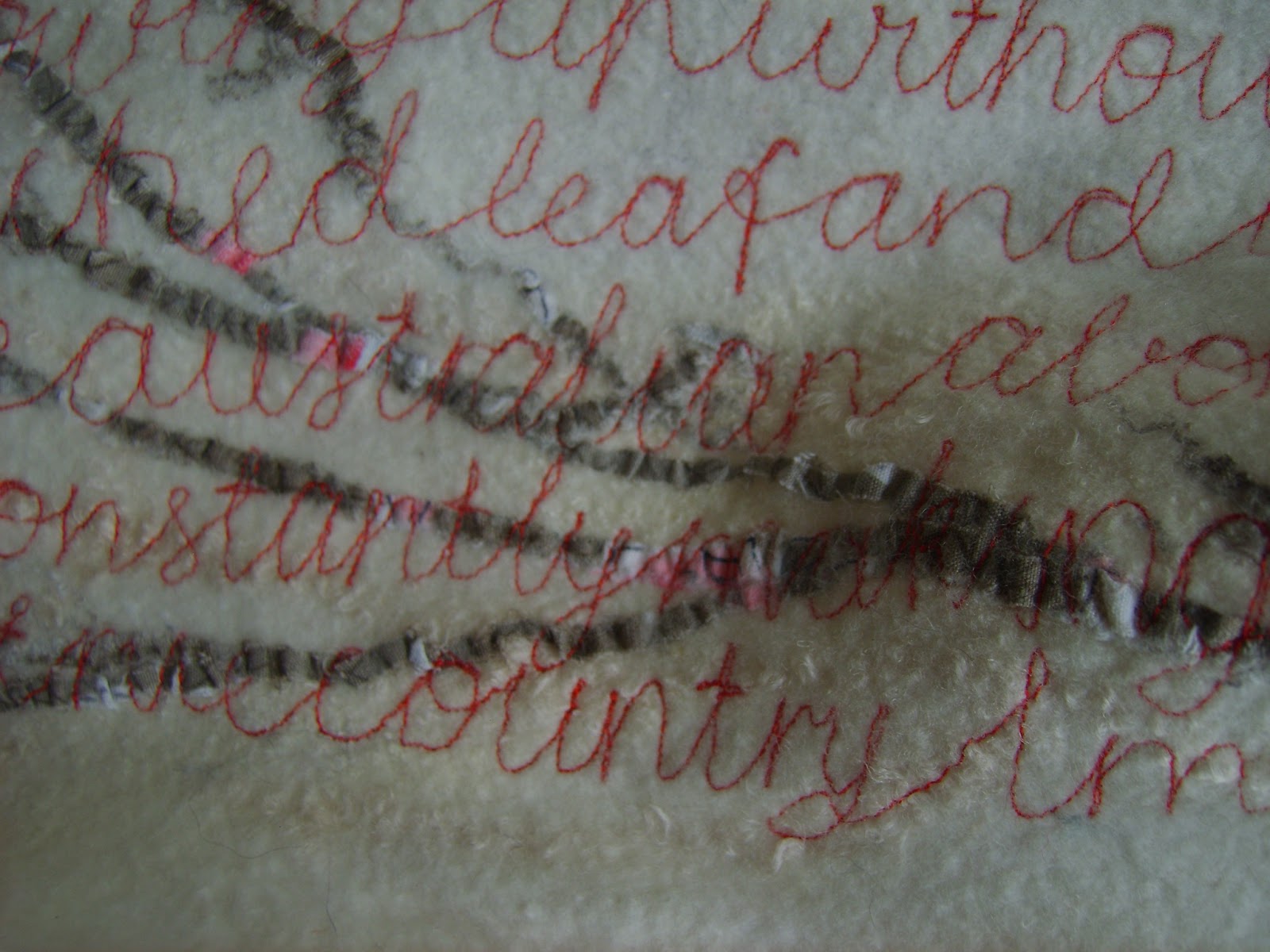
How to sum up this ‘subject’ of home in a scarf representation when it has taken most of my adult life of exploring to discover what home is, and where it is…I started where I left off with this inquiring into home and belonging.  A woman with roots in air like the banyan…deracinated…my roots never seemed to have taken in the new country where we were called ‘New Australians’.  Sometimes the customs of your adopted country can move you in unexpected ways. For the Australian Aborigine the land is not separate from the soul and to gaze upon country is like beholding the self.  But the person needs to travel through it, naming it, constantly making new stories.   Yes, I have ‘appropriated’ this belief of the Songline – with a twist – seeing the body as landscape, as geography, in which to settle. After traveling back and forth between the new and old country, gathering and writing stories about my kin and those not of my kin became a way to gaze upon my-self and behold my country.  Now middle aged, I’m settled in the skin I’m in.
Scarf I, I added a tree using sari fabric scraps which bled into the white ground of the felt
Not quite a banyan tree but a flame tree, with aerial roots exposed

So how to ‘represent’ ... as writing and stories are significant I decided I would tell this little story about ‘home’, what it’s taken to realize where home is.  Also I like to trace the roots of words (etymology), and words seem to have formed my roots to things, as indeed have stories. There are lines from a Talking Heads song ‘This must be the place’, yes I’m already there; as well as words from John O’Donohue’s book Eternal Echoes, which has as its theme our hunger to belong.  I also wanted to incorporate some fabric from that dressing gown that my mother wore while she awaited my coming into the world, and which was made by my grandmother.  I have already used the fabric in my ‘story cloth’; later I incorporated most of the skirt in an upcycled dress, but I thought to send some of the threads and shreds of the fabric on its own journey into the world, even if they end up in some landfill, somewhere, rather than hanging onto it as ‘precious’…torn bits were used as roots, but also to evoke my ‘songline’, stretching back to ancestors and creating my story.  They also remind me of ‘veins’, arteries of the body, and arterial roads in a landscape …the ‘red on white’ – filled not unlike the pages of a notepad.  I was told, most likely by my mother that it was bad manners to write in red ink and I so dislike teachers who scribble in red ink all over the pages of their students’ work – their ‘corrections’.  I suppose I decided on red thread because of its association with blood, earth and passion and because it is ‘impolite’ (I admit to a rebellious streak) – and when the red from the dressing gown fabric bled into the white wool I wasn’t concerned about the stains (though surprised as the fabric is so old).  Those crimson sari fabric scraps from which I formed a tree, also bled...interesting how you can 'know' but still intuition prompts you to use them regardless. These scarves had a becoming of their own. I’d intended to euca dye them but found on ‘writing’ upon them that they were already ‘full’ and busy – ‘finished’.  With the first scarf, as I was learning to write in poly thread with my darning foot, the writing became rather like my own handwriting, which can start off large but then gets smaller the longer I write. The writing is continuous without a comma or full stop, as Cesaire, poet of Negritude showed me – language running away with itself like the marrons (runaway slaves).  I’m sure for the ‘civilised’ the writing on the scarves will seem like babble.
Rayon embroidery thread used in this one, which made a difference as it seemed to grab the felt much more

Scarf II the writing is much more even

Perhaps a dyed euca leaf or two wouldn't go astray?

They’re not the most beautiful scarves and perhaps these ‘themed’ exhibitions end up with lots of works that are meaningful, intrinsically personal, but not necessarily beautiful or sale-able ‘products’. 

I’m home – despite not looking and sounding ‘right’ but New Australian - in this Creole body that I’m in – this not quite white skin that stretches and forms my country…All the searching and questioning for naught, when I was already there... 


Notes
Words from a book, 'the body is a home which shelters you', John O'Donohue, 2000, Eternal Echoes, (HarperCollins, Paperback) 
For a quick review of Songline and a more in-depth understanding see, Barry Hill, 2002, Broken Song, T G H Strehlow and Aboriginal Possession (Knopf)
For Aime Cesaire
Words from a song...this must be the place...yes I'm already there...

Saturday, December 22, 2012

Raising Maudie


I made a pact with myself that I wouldn’t produce as much felt this year – that I’d focus on raising Maudie, particularly when Coda was killed one morning while I was focused on my stuff in the studio. We’d had Coda for a little over a month and I had ‘shared’ responsibilities for her with P, my partner.  Actually, P took the greater part of it: feeding her, walking her, teaching her ‘tricks’ such as how to use a bell to tell us she needed to go outside to toilet, teaching her how to ‘go to her room’.  Coda was a runner.  She’d had a traumatic beginning locked up in a small apartment while her ‘parent’ was at work; and she’d more than likely been physically abused.

A dog needs attention – time spent playing, as well as the discipline of walking and the quieter moments to chill out.  It’d been a while since I had a dog and dogs had become my shadow animal – terrorized in dreams by Cerberus.  I had become fearful of dogs and found myself crossing to the other side of the road to avoid encountering a dog, even if that dog was pint size.  Coda was different.  It was love at first sight when we were introduced.  I thought her sweet natured.  She was – but perhaps she’d had the aggression beaten out of her.
First days at home, finding comfort in the cat's cubby
She was like a big rat when we first got her
First lesson, 'Watch' Maudie
I've got her on such a short lead
First graduation from beginner's class
First Road Trip
From the moment we brought Maudie home at six weeks of age, she was bossing me around.  At three months, she wouldn’t accept discipline from me.  She’d growl and bark.  She saw herself as above me in the hierarchy of the pack and I’d given her cause for that.  We have a tendency to anthropomorphize animals and attribute to them human qualities.  I have learned in the past twelve months to think more like a canine and to assume the leadership that Maudie as a young pup deserved from me. When she jumped up on me – it wasn’t to look soulfully into my eyes - or perhaps it was to see me at eye level – and to assert her dominance.  Jumping was accompanied by growling and barking.  She reduced me to tears. I read and watched tutorials on how to handle aggression in dogs and tried to change my attitude and being with her.  I took responsibility for her feeding and handling. We enrolled in Dog School for training.  When I thought I could take a back seat – I was now the main driver.  
Having my morning coffee as Maudie joins me on the couch

Having a puppy was not a joy – as a few friends continually reminded me.  The bond required work and time, as well as patience. Choices – to spend time with her – not only disciplining her but playing and having fun. I was unable to hold her on a lead when she got excited by the sight or smell of another dog, or the sighting of a bird or another human being. It’s a mind game.  It requires assertiveness and confidence on my part to think and feel that I can do this – that if she remains calm, it’s because I have the assertiveness to be her leader. However, when it comes to holding her when she’s excited – I’m still failing.  

I find it intriguing that having a dog is teaching me about how I am in the world and in my relationships. I’m neither a leader, nor a follower.  What I am is someone who has chosen to march to the rhythm of her own beat – and as an adult I haven’t had to bring up a child or a pet.  I preferred to have a pet rock to a relationship.  Of course people who knew about my pet rock thought I needed sympathy or therapy – but I chose a way of life that didn’t require much from me, and where I wasn’t required to have much responsibility for others.  I could lie in bed and write – and more recently I could spend time producing felt.  A pet rock is perfect for someone self absorbed like me. I thought with Maudie, as with Coda, that I could sit back and enjoy an occasional cuddle without putting in the time, without taking any responsibilities for her development.  But to survive in this pack or family requires living differently. As with any other relationship, I needed to put my weight into the relationship with Maudie.

With the onset of Winter, when P decided he needed a few days away to get some sun and see a football game, it meant Maudie would be all mine for those few days. I was anxious about how I’d cope if she jumped or growled, or if she started bullying Jose the cat.  She’s not so cute baring her brilliant large canine teeth.  Surprisingly rising to the task I was able to be the strong leader (not as strong as P) but strong enough, none the less.  I made time for walks, throwing a ball around, for training and learning tricks. I also decided I needed a 'Gentle Leader' collar for our walks, as she pulled too much and it made walking with her exhausting and not much fun for me.

Then there’s Dog School every Sunday morning, come rain or shine.  Maudie and I have passed Class 2 and are in Class 3 working towards off lead and agility training. I would even like us to do ‘dancing with dogs’ if she shows an aptitude for it, as I can’t get P to go dancing with me. Surprising the twists life can take.  A year ago I never would have imagined myself at a place where there’d be over a hundred dogs training or socializing. 

What’s suffered is my creative life – but isn’t that the case for any creative woman who makes the choice of raising children.  At the risk of offending those with children, raising a dog is no different. Unlike a child you can tie a dog up, put her in her crate, or put her in dog care, but that’s not growing a relationship or trust.  Keeping up with a puppy requires twenty times more energy than keeping up with a toddler child; and puppies can be more destructive when they don’t get the fun and stimulation they need. Nearing Spring I thought Maudie had become more trustworthy.  I could leave her for short periods of time without supervision, and she would take herself off to bed, or amuse herself with her toys. Jose had taken up residence with its actual ‘mum’ and he wasn’t around for Maudie to hassle to play when all he wanted to do was sleep.   I took up a little sewing, within earshot or sight of Maudie. Then one day I let her outdoors with a treat but forgot about her when I became engrossed in the task I had  – then thought she was awfully quiet and must be up to no good.  I was right… she was ‘playing’ with one of the chickens that had flown out of its run.  The chicken had to be killed because it had sustained several wounds and its gizzards were exposed. 
She can now sleep on the couch in my studio without running off with my roving, prefelts or plastic

Recently celebrating her first birthday with carrot and peanut butter cupcakes


More recently I have begun to spend time in the studio and Maudie will wander in and if she behaves, has been allowed to stay.  So she may become a studio dog after all. A creative woman's dog.

Now she's becoming a joy to know and have as a pet and companion. P has rigged up a backyard 'agility' course, and we can both take the opportunity to practice with Maudie during the break from school over the holidays, while she also has some exercise and fun.  With the days hotting up, the pavements and streets are too hot for Maudie's pads and our walking jaunts have been curtailed.
P leading Maudie into the Zig-Zag

Of course I crave the times when I used to only have a pet rock.  It demanded less of me as a person and I could lie in bed and indulge my whims like Proust.  But that's not what becoming a person is about, and a dog can certainly add to our lessons about that...