Sunday, February 19, 2012

'Gawd he copied ME!' In part 1 Rembrandt speaks out about his copyists


(Joni) I’m not sure where to start – so let’s try a phenomenological interview.  What was it like Rembrandt to watch your canvas drink up black – an image given by Joseph Heller in his book Picture This?

(Rembrandt) Well – to build up form you need the dance of dark and light – Caravaggio…

Allow the canvas to drink more black and the light emanates from a different spot?

It is in the juxtaposition of light and dark. I aimed in my work to give the greatest and most natural movement of it.  Can you not see it more clearly in my etchings?

Yes – it’s stark for instance in the portrait etching of Jan Six…those velvet blacks heavily etched beside the non worked and non inked areas – left as light.  These areas of negation and of silence I have always found to be metaphysical.
Heller wrongly calls the picture he writes about as ‘Socrates contemplating the bust of Homer’ – as it is actually the painter ‘Apelles contemplating the bust of Homer’ – well according to Schama.

The subject matters not – what is important is that the viewer can go into reverie in front of the painting and he imagines it as whatever he wants. I’m not at all miffed.

It was suggested by the historian Simon Schama in his book Rembrandt's Eyes that you identified with Apelles, worked as he did – projecting from the surface and keeping your palette close to what he used – the four colours of black, white, ochre and earth red?

Could be another reverie…

Yes I find that he goes into free association in front of your pictures.  Your Dutch contemporaries had little time for reverie or imaginatively finishing off your pictures – other than Huygens and he was one of your best viewers. 

Idealism and smooth surfaces were ‘de rigeur’ just when I wanted to paint in a freer rougher style. Jan Six too was unhappy with his painted portrait and did not commission me for the painting of his wife’s portrait when he married.  I made the passages closest to the viewer the freest in handling.  But there was also the finest of details in other passages.  More and more I wanted the brushwork to convey the essence of the sitter. 

Can you tell me about what it was like for you when your students became more popular for painting more like Rembrandt?

What do you think it was like!  What a question! 

That’s the phenomenological approach – that I know nothing.  I need you to describe what your experience is.

My experience?  Can you not imagine?  Famous and assuming that I would be rich – set up for life – and then reduced to poverty because of what is popular and that is what I had made popular at one point.  Had I painted what was popular I would have made the sales – I was driven to paint other than what was popular.

Tell me about what drove you?

It was not money!  If I had been driven by money matters, I would have painted what was popular and what would sell – what they thought was ‘Rembrandt’.  I was not allowed to develop as an artist …

I realize that so many of your biographers portray you as the prodigal.  You depicted yourself as the prodigal with your wife Saskia as your whore.

I beg your pardon…immersing ourselves in the roles we were playing. We had fun with that one. I also took on the roles of beggar, king, executioner, immersing myself in the ‘experience’.  A painter can do that!  Painting a history or someone’s portrait, you begin to live with the image as you apply the pigment and glazea part of you goes into that as well and not just through the gesture of painting.  You put on you take off – much like clothing.  And you form your favorite way of putting on taking off – what some call ‘style’.  And really it’s what you feel comfortable with.  What your soul wants to live with – as a painter I tried on different clothes or different roles.

Can you tell me more about what was comfortable for you to live with both in role and as style?

I retract the word ‘comfortable’.  Sometimes I was neither comfortable with the roles put on nor painting.  The portrait as prodigal for instance – seemed as a dark omen now.  But painting - playing with it this way and that – getting it right – you put on you take off – then there comes a time when it seems to be working and you like it and you think you’ve done that passage here well.  But the beauty of it is that you can change it – unlike the mistakes of life which you find you can’t take back.

Did you want to elaborate about that?

Certainly not! – We’ll stick to painting… because the surface is so manipulative – and there are the possibilities to rework and change – your confidence grows.  You feel you can do anything…for instance the way I drastically cut down and reworked the Claudius Civilis from a 6 metre painting to something measuring 196 by 309-cmIt was torture but I did it because I had to make a quick sale after the Town Hall patrons refused to hang it in the place for which it had been commissioned. It was too unconventional!  Cut down it became a better painting, more confrontational with the figures pushed up to the frontal plane; and Claudius cuts a truly dynamic figure with his third eye gleaming from the jewel in the headdress. Claudius only has one eye staring into space and the other is a gashed cicatrice… ‘But if thy eye be single…’

Yes?

‘If thy eye be single, thy whole body shall be filled with light.’

That drove you most of your painting life!

Yes – the message is so overt in one painting. But there were others where the eyes were hidden, or the eyes were shut and still I managed to convey that the body was filled with light.

You take my breath away.

Thank you – dear… but I wanted to do the opposite.  Put the breath into the figures – bring the subject to life. Today they live.  No one remembers Govert Flinck.

Indeed no one remembers. With the Claudius Civilus, Flinck had won the commission for the work on the Town Hall - 8 huge paintings depicting scenes from Tacitus’ ‘History of Batavian Revolt against the Romans’.  But Flinck unexpectedly died with only the preliminary drawings executed –

What fabulous luck and I was among three artists taken on to finish the commission!

(Extracted from a phenomenological interview with the painter in 2005)

Monday, January 23, 2012

What an arch can suggest for friendship


An arch is two weaknesses which together make a strength, Leonardo suggested when talking about buildings, but I think we can apply it to an idea of friendship.  When you look at an arch – the forces that compress need to hold together in a state of equilibrium.  Great and sustainable friendships are like the arch.  You will probably find that when one puts more weight in than the other does, that either one or the other or both, will collapse.

Sure, it is an ideal but we need not have to relinquish parts of ourselves to be in relationship with another, and we need not have to give more than the other is prepared to give.  Equal weight, balance, and negotiating the spaces between until that is achieved.  That in between space where the two weaknesses come together, where the compressive forces meet, the ‘third space’ (what theorists nominate as intersubjectivity), is actually a place where we find nurture and where we can birth and nurture something ‘other’ - be it our 'self' or a work of art.  Often it is the place where love grows.  I tried to capture this experience in a simple drawing some time ago – visually it captures an impression of what I mean.

Comfort (2002)

I bring up the idea of friendship or relationship as an arch, as a justification for my penchant for working collaboratively.  In collaboration, I either find or remember an aspect of myself or find a possibility for re-invention.  This is the way I have experienced that most primal of relationships - with my mother, who is my best friend.  She has always been a fabulous storyteller and our engagement through conversations now that her best friends have passed, have allowed her to continue with her story telling.  I've even been compelled to write down these stories before they pass with her.  In between, in the ‘third space’ is the expressive woman, which we both share.

What came to be called the ‘Friendship Scarf’ happened accidentally.  Fabienne Dorsman- Rey had sent me a few eco-dyed samples after I’d packed her an envelop full of eucalyptus leaves found in Sherbrooke Forest close to where I live - what you can call my ‘backyard’.  The bits from Fabienne weren’t enough to make a piece but I was so touched by their unique beauty that I wanted to make use of these ‘samples’.  So I started to sew them together along with other bits and pieces that I had – sari remnants from Glitz and Pieces on Etsy, other silk and cotton scraps until I had enough ‘carrier fabric’ for a nuno felt scarf.  I wanted to work in a way that left the beauty of the eco-dyed fabrics and sari remnants exposed as much as possible.  While I was ‘playing’ with this scarf, touched by the friendships that have bestowed all bits upon me, I was also making a few scarfs to enter in the annual Melbourne Scarf Festival.  I had never intended that the mosaic scarf would be entered in the event.  When Philip looked at the ‘results’ he thought the mosaic scarf was the best of the lot and that it needed to be part of my contribution to the festival. 

‘But I don’t want to part with it,’ I told him.  If I did part with it, it would go to Fabienne.  Then I thought if I priced it highly enough no one would buy it – even though priced, as it was, it was still a bargain given the hours of labour in the scarf and its psychological significance.  The theme of the festival was ‘the rhythm of my day’, and serendipitously it fitted easily with Facebook being a part of my day, and where I’d encountered my friends and been enriched both creatively, and personally.

The Friendship Scarf I

Detail of the back showing a piece dyed by Fabienne, and a sari  remnant bought from Glitz & Pieces 

You can see various bits were sewn together


The wrong side of the fabric
I wrote as my caption for the exhibition: 'The rhythm of my day – FaceBook and friendships forged with artists on-line.  An eco dyer in Amsterdam; a seller of sari remnants based in India; whose auras are present in this scarf.  I have collected leaves from Sherbrooke forest and sent them overseas, then received the ‘fruits’ in pieces of dyed fabric and I’ve been shown how to create my own eco dyed bundles.  Conversations, learnings, laughs, amity.'

I considered the scarf as a co-creation, in which not only bits and pieces from others came together to make one work, but as well, those bits enabled me to approach felting in a different way to what I would have normally. For me it inspired love - love of the materials, the process, and the people involved.

The scarf was subsequently bought by a woman who fell in love with it. 


The full quote from Leonardo's Notebooks is 'The arch is nothing else than a force originated by two weaknesses, for the arch in buildings is composed of two segments of a circle, each of which being very weak in itself tends to fall; but as each opposes this tendency in the other, the two weaknesses combine to form one strength.' http://www.fromoldbooks.org/Richter-NotebooksOfLeonardo/section-13/item-779.html


Saturday, December 31, 2011

The Creator’s Dog


Coda, our dog was killed and at the time I’d been unpicking my mother’s dressing-gown. I received a phone call from a woman letting me know that she had Coda and she’d been struck by a car.  I went into mourning for several days and didn’t feel like doing anything, particularly that which had consumed me that morning.  In the scheme of things, it didn’t seem important.  During loss, most things do not seem to have meaning.  Of course, I knew that creating would pick me up but I couldn’t be bothered.  I preferred to mope and some would say even indulge the hurt I felt for losing Coda.  I couldn’t get over how she was full of life one minute and not the next.  She looked peaceful lying in the back of the car after my partner picked her up from where he believed two women had dragged her after she was struck. 

The driver of the car that killed her didn’t stop.  But it must have been a shock when life was wrenched from Coda.  We went through all the what ifs – what if I’d been gardening that morning she would have to have passed me on her ‘flight’ towards the back lane and then the main road and she may have been distracted from her purpose by seeing me.  What if Philip hadn’t left the gate open because he was preoccupied with covering up a hole that Coda had dug under a wire fence?  We realized however that if not now well – then another day…It was something that was bound to happen because Coda liked to run and visit her doggie friends up and down the lane.  I nursed guilt as well, that instead of being absorbed in my creative pursuits, perhaps I should have given her more attention.  What made Coda the sort of dog unable to sit quietly at my feet, happy to be near?  A sort of creator’s or philosopher's dog – happy to ‘think’ and dream alongside me?  According to a Kato Indian Creation story when God went forth to create the world, he took his dog with him.  As I want to do when I go forth to create (not the world) but some felt, or indeed, to muse or write.

I perked up when we decided to get another dog to fill the hole in my heart and the void in our house.  So I went back to unpicking those used dresses and the reflection that it brought.  It may seem that Coda as a dog is replaceable and that the thought of a new dog brought relief from my grief.  I am rushing to replace her and it's related, however, to my incapacity to be with ‘the hole in my heart’, which makes me want to rush and fill it with something, rather than attend to the pain. That sort of inability to deal with pain and loss, which caused me to happily have a pet rock for almost a decade, before I could consider having an intimate relationship with a man or indeed, a dog.  Granted I was doing it rather backwards on the way towards intimacy (the man and then the dog but if you consider the dog like a child and we its parents, I've got it right)...

I miss Coda and I swear I can hear her barking in the yard (while it may only be the wind in the sails that provide shade at the front of the house).  There are so many butterflies in the garden that I associate with Coda’s ‘soul’.  Whenever I sight them, they make me feel light.  We as humans tend to attribute ‘minds’ to animals because we have minds. (What minds are exactly is complex, and I may leave that to another post.)  I purchase the book The Philosopher’s Dog by Raimond Gaita, hoping to find out something about the minds of dogs, indeed what Coda may have been thinking about when she flopped on the mat at the front door and heaved a huge sigh.  Those sighs my mother reminded me as a young girl, ‘are for the desires of the heart that are unfulfilled.’ 

Seeking out the chickens
What were Coda’s desires?  Did she think about the Lab called Poppy that lived up the lane and was often at the front gate, or the Staffordshire terrier – Tank with which she’d grown up?  

Is she thinking, caught in reverie?
While I don’t think that dogs ‘think’ or examine experiences as we do, searching for meaning, they must have ‘minds’.  What made her cower when she messed the floor ‘thinking’ that as her previous ‘master’, I would strike her?  What made her seem depressed after she’d been to the dog park?  She wasn’t allowed off her lead to socialize with the other dogs, as it had been her first time.  Was that the reason?  Was she reminded of doggie fun and mischief with Tank?  Usually full of zest, she moped for several hours.  She was on the mat beside me for once (not as I created but as I ironed) and it seemed for the wrong reason.  Not to be with me, but because something else preoccupied her and she was down.  Some people would think I’m batty attributing a ‘mind’ that can reflect to a dog.  She seemed as an individual sentient being, and one that could seek out the individual company of humans, other four-legged creatures or even the feathered two legged kind in chickens – the same individual that I fell in love with at first sight.  Never mind that she had four legs, she had beautiful kohl rimmed eyes and a great smile.  She could ring a bell when she needed to go outside (to the toilet) and she rang the bell to let me know that the cockatoo was eating from the bird feed.  (We don’t like cockatoos eating from our bird feeder because when there’s no birdseed they can revert to eating the timber on your house.)  What other evidence did I need to suspect that Coda had a mind?  She could learn.  She had memories.  I'm sure she dreamed because I watched as she seemed to have a nightmare once, quivering, and (did I imagine) rapid eye movement…

Did I learn anything about a dog’s mind reading Gaita’s The Philosopher’s Dog?  Well, Gaita would assign sentimentality to my way of thinking.  Very simplistically, because dogs don’t reflect on the nature of death, in the way that humans do, acutely aware of their mortality, they don’t have a mind.  Yet Gaita seems to contradict himself when he recounts the anecdote of the aged Gypsy (his dog) slinking past a gate behind which a younger and rather neurotic border collie waits; and the sidelong glance Gypsy gives, which seems to express her humiliation at being old.  Gaita is tempted to say that his dog’s demeanour expressed an awareness of their common mortality.  But he’s sure she does not know that she will die.  I agree that young dogs are too busy living in the moment to contemplate death, just as young human beings don't reflect on death or feel their mortality.  I’m sure that when Coda went through the gate and towards the garden and running down the lane towards the main road that death was most further from her mind, as it was from mine.  While Philip expected it, I did not.  I liked Coda running and exploring, free as butterflies, and I did not expect her to be stopped dead in her tracks.  We were both naïve. 


(The Kato Creation Myth is recounted in Raimond Gaita, The Philosopher’s Dog, Text Publishing, 2005) 

Monday, December 26, 2011

The Saga of the Ugly Dress or the Repurposed Dress


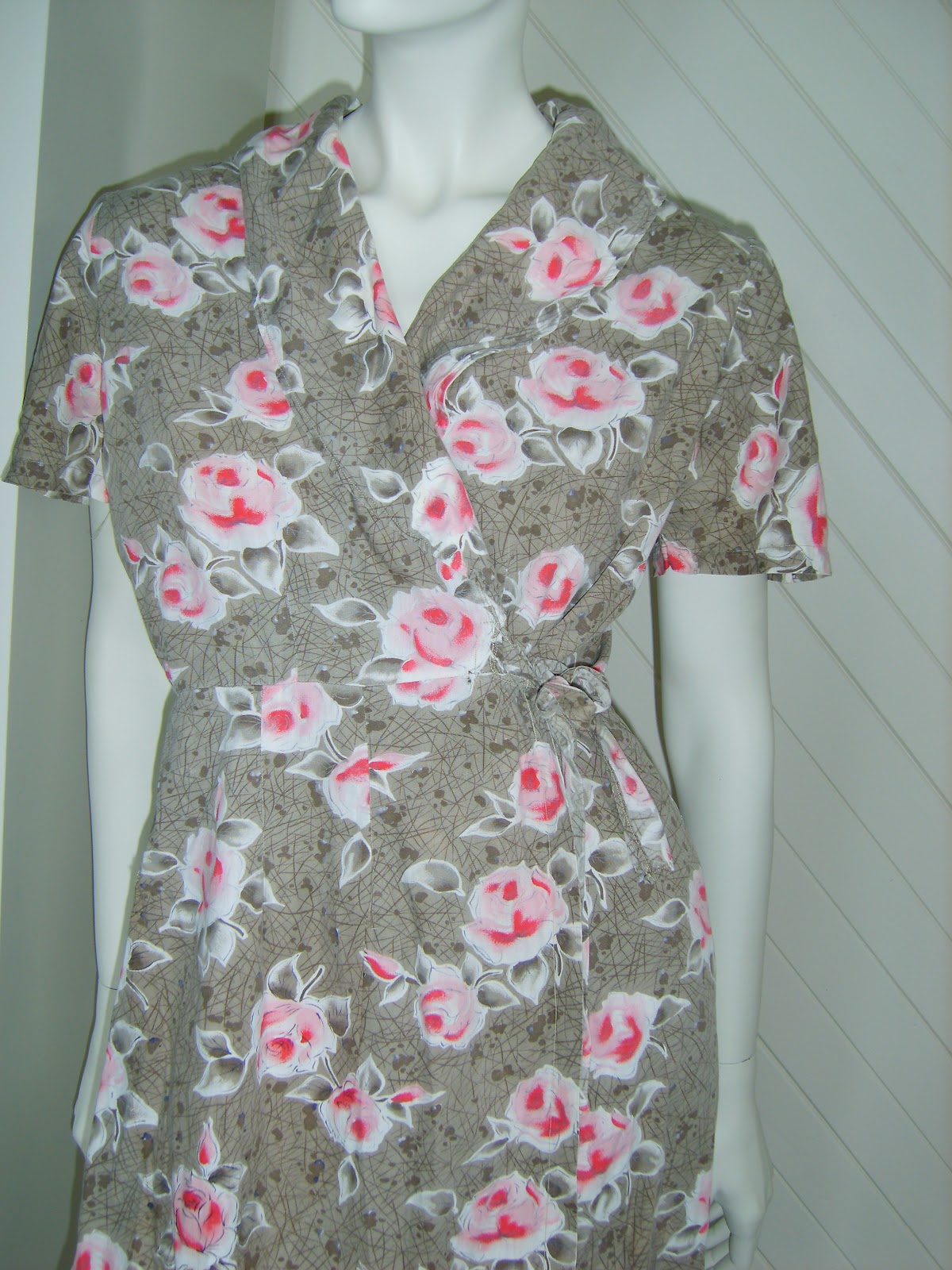
My grandmother would have been OK with the ripping of this 50 year old dressing gown to recycle, as she did that often.  I recall (and I’m certain I’m not making it up) as a child I watched as she turned old curtains into flounces and puff sleeves for my dolls.  She worked this way because of poverty.  My mother recounts how she recycled khaki ex-army uniforms into serviceable clothes for her children.  Now the ‘upcycled’ way has become fashionable and claimed by designers.  It occurs what I'm doing may be a bit of a ‘Nan’ thing. 

Madelle wasn’t the neatest seamstress.  She didn’t even bother taking out the tacking she’d put in to guide her machine sewing.  I find these personal, or hand tracks touching.  I’d virtually ripped apart two other ‘used’ dresses but with this one I tried to be patient and not rip the seams apart.  Once or twice, I did begin to tug and the seams are sewn so tight that the fabric came away rather than the stitching.  Be gentle and patient I encouraged myself.  Patience is not my forte.  Making a dress this way is certainly a lot more time-consuming than starting from scratch using new fabrics by the metre.  Unpicking is rather like weeding.  Both give you time to reflect.

What I’d like to say to her if I had been looking over her shoulder is ‘not so tight Grandmere…loosen the tension a little.’  Because one day when I decide to unpick it and use the fabric for something else, I’m going to have a hell of a time doing so.  I notice the fabric of the seams are much darker than the rest and there will be stitch marks left like ‘scars’ – tell tale signs that this was once something else.  It is a lot like life that leaves us with emotional or physical scars.

The thing that strikes is that this is not a sustainable way to make a dress.  It’s taken me many hours to unpick several dresses, including the dressing-gown to have the fabric required for me to cut my pattern pieces for the London Peasant Dress designed by Lila Tueller.  My own labours, the time, the electricity – surely they kid when they call it ‘sustainable’?  Moreover, repurposed clothing in general costs more because of the hand-hours of labour.  Is it enough to say that it is ‘sustainable’ because it prevents old clothing from entering landfills? 

It was only after I had cut the skirt of the peasant dress that I realized the pattern has a nap and had not been cut and sewn according to the nap by either my grandmother or the maker of the other dresses.  A detail that would not have escaped my attention.  I assumed that because two dress/skirt pieces were sewn together that the pattern for each piece ran the same way.  You have to make do with these ‘mistakes’.  It would have been quicker to have nipped down to the local fabric shop and bought some cheap fabric for my peasant dress.  I have unpicked three dresses sent to me by Dawn Edwards which didn’t fit, my mother’s dressing-gown and a skirt I bought almost two decades ago, whose elastic had slacken and which I’d kept because the fabric is so pretty.  Two of the dresses that Dawn sent were lined giving me almost twice the unpicking. 

It may be a trend with celebrities like Livia Firth to wear a repurposed gown but somehow it still comes off as being glamourous as their original and repurposed are from designer labels.  Whereas my dress strikes me as being an ugly dress.  I will have to wear it, and wear all the insults people will say.  ( I once made a pair of knee length wool pants and wore them with tights and I don’t know how many people asked whether I’d run out of fabric…)  I can imagine what will roll off the tips of tongues ‘what a harlequin dress!’ or ‘it’s a dog’s breakfast’, ‘did you run out of fabric?’  In fact yes – or I was trying to use what I had.  My partner Philip on seeing me try it on suggested ‘you won’t find that in Target’.  Indeed. 

I’ve been pondering the idea of beauty versus meaning during my labours.  Keats has told us ‘beauty is truth, truth beauty’.  This is my search for a kind of truth, which I find beautiful –  that I have been able to use fabric that is half a century old.  I like to make beautiful things but I’m also in pursuit of meaning.  While I have been motivated to make the most aesthetic garment using what I have available to me, I have been restricted by what was available.  I don’t for instance have access to those designer gowns that make Livia Firth’s upcycled gowns for The Green Carpet so glamourous.  The history that my mother wore one of the fabrics when she was pregnant with me, and that my grandmother made it– touched by two beautiful women – that aspect is beautiful.  I like the aspect too – that I was able to use the dresses that Dawn sent, bought from thrift shops in the States, even though she’d sent them to me because she was averse to cutting them up.

What’s lead me to the making of an ugly dress – I wanted to use the hand me down dressing gown because I’m unable to pass it down to a daughter of my own.  Would she have cared anyway?  In any case – to wear it in some form.  It has been ‘repurposed’ and it tells a story – not so much that I’m interested in recycling old clothing but that nothing much has altered from one generation to another even when it's skipped a generation.  Like grandmother Madelle, I have made a dress from recycled fabrics.  Philip describes the making as a ‘labour of love’.  I know it has been a labour and perhaps at the centre of it – is love...I wore the dress on Christmas day eager to see whether my mother would notice her dressing gown was now repurposed.  Of course she did...'Did you know,' she said to Philip, 'that was once my dressing gown.  In fact it was the first dressing gown I'd ever had and I wore it when I was pregnant...'